
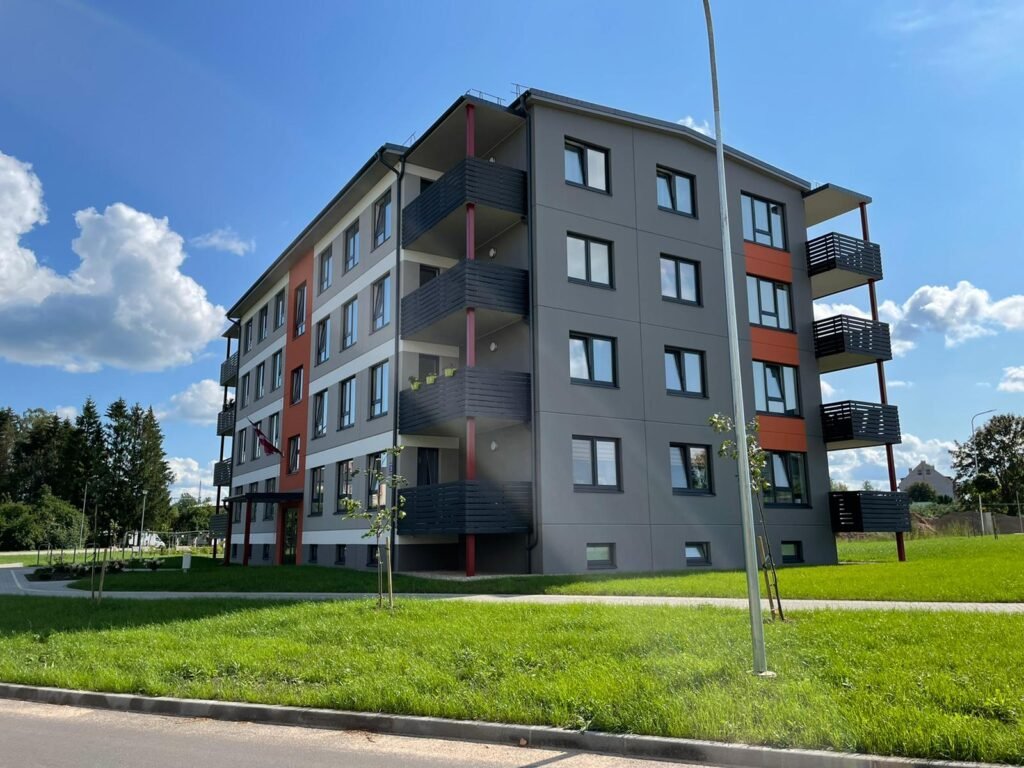
Housing for internally displaced persons built with donor funds in Ukraine is designed with an energy-efficiency margin. In the NEFCO and EU programme for IDPs, buildings reach class B — about 58 kWh/m² per year — and are complemented by heat pumps and solar panels. For a municipality this means lower bills for residents and a better score for the project with the donor.
The wall is the easy part
In a precast building the external wall is usually a sandwich panel: an inner load-bearing concrete layer, insulation and an outer protective layer. The insulation is placed in the plant over the whole panel area, so the required thermal resistance of the wall is easy to achieve. Ukrainian code DBN V.2.6-31:2021 “Thermal insulation and energy efficiency of buildings” requires external walls of residential buildings to have an effective thermal resistance of at least 4.0 m²·K/W in temperature zone I and 3.5 m²·K/W in zone II. “Effective” is the key word: the resistance includes all thermal bridges — joints, ties, details. The panel itself with sufficient insulation meets the requirement; the question is what happens at its edges.
Heat is lost at the joints
The real work starts where panels meet each other and other elements:
- Panel joints. Insulation must be continuous across the joint, and the joint must be airtight.
- Slab bearings. A floor slab entering the wall must not cut through the insulation layer.
- Balconies. A cantilever balcony slab is a classic thermal bridge; it is separated from the warm envelope by a thermal break.
- Windows and doors. The position of the frame within the wall decides whether the reveal will be cold.
- Ties between panel layers. Heat can also pass through them, so their type and number are part of the thermal design.
We calculate each of these details and show it in the shop drawings the plant works from. Energy efficiency is then built into the product at the plant and does not depend on how the crew copes on site.
What it gives a municipality
- A building that meets the donor programme’s energy class requirement.
- Factory-quality insulation — no wet processes and no seasonal limits.
- A standard section that can be repeated on other sites with the same thermal solution.
If your municipality is preparing an IDP housing project that requires class B, contact us — we will show how it is solved in precast concrete.
More about our approach: Precast housing for Ukraine’s recovery. To discuss a project: contacts.
Discuss your project
Tell us about the building or the task: building type, number of apartments, site and funding programme. We reply within one working day.